
Three-Year SPRIND Circular Biomanufacturing Challenge Concludes:
TUHH Spin-off EveryCarbon wins with Circular Polyester Prototype and Resilient Biomanufacturing Platform
21.10.2026
The jury of the SPRIND Challenge “Circular Biomanufacturing” has selected EveryCarbon, a spin-off from Hamburg University of Technology (TUHH), as the winner. The challenge was to develop an end-to-end prototype production platform capable of converting various carbon-containing waste streams into new products through a continuous biomanufacturing process. The prototype had to demonstrate how carbon-containing waste streams could be processed and fed to microbes as nutrients, while maintaining continuous production for at least 180 days during the challenge. The final objective was to produce at least three different products using a modern manufacturing process. “We started with a bacterial strain and a sketch on paper. SPRIND set the goals and gave us the freedom to find our own way, and the team made full use of that freedom. Now we are bringing ECOne™ to market and making every carbon atom count,” says Sebastian Beblawy, CEO and co-founder of EveryCarbon, celebrating the team's success.
The challenge began in November 2023 and ran for three years in three stages. In Stage 1, eight teams each received up to €1.5 million. In Stage 2, six teams each received €2.0 million. In October 2025, the expert jury selected the participants for Stage 3, in which each team received up to €2.5 million over twelve months. After one and two years, the jury reconvened to assess progress and determine which approaches had the greatest potential for breakthrough innovations and which teams were most likely to succeed through to the end of the challenge. Four teams completed Stage 3.
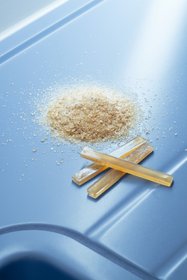
Through fermentation and chemical synthesis, the EveryCarbon team is giving organic waste from across Europe a higher-value use than biogas: ECOne™, a bio-based polyester for insulation materials, hot-melt adhesives and injection moulding applications in the construction, automotive and electronics industries. According to the team, ECOne™ absorbs as little water as conventional fossil-based plastics, retains its shape under heat and generates fewer CO₂ emissions during production.
The team operated its fermentation process continuously for 180 days, without contamination or antibiotics. EveryCarbon built a container-based mini-plant at a wastewater treatment facility, developed a digital monitoring system for the next stage of scaling up and established the company earlier than planned. According to the company, it has received letters of intent from construction companies and material manufacturers. Pilot production is underway, and the team is now preparing to scale up to commercial operations.
“We are very proud of what we have achieved together with the teams through our Challenge programme and of how we have been able to support them on their path to commercialisation through our mentoring programme,” says Patrick Rose, Innovation Manager at SPRIND and Challenge Lead.
The other teams also successfully carried out continuous fermentation processes and developed their own products. C3 Biotech produces acrylic glass from agricultural waste, Biophelion develops cost-effective fungal bioprocesses, and Amphistar produces biosurfactants from used cooking oil.
What's Next
The challenges of biomanufacturing are far from solved. So far, breakthroughs have been limited to niche applications. The long-term goal remains to manufacture the majority of mass-produced goods using biomanufacturing processes based on locally available raw materials. All four teams now face the task of scaling up from pilot plants to industrial production.
The Jury and Challenge Team
The jury consisted of Petra Oyston, Clem Fortman, Deepti Tanjore, Julia Schüler, Rob Carlson, Ryan Ritterson and Michal Harari. The challenge was led at SPRIND by Patrick Rose, Innovation Manager and Challenge Lead.
About the SPRIND Challenge “Circular Biomanufacturing”
Further information: www.sprind.org/de/challenges/biomanufacturing
TUHH - Public Relations Office
Elke Schulze
E-Mail: elke.schulze@tuhh.de
Phone: +49 30601 4040


