
Nature Food Study
Land Degradation is already Reducing Global Food Production
23.07.2026
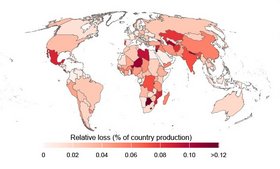
A new study published in Nature Food reveals that land degradation is already having measurable impacts on global food production, highlighting an urgent need for investments insustainable land management. The international research team, including Professor Nima Shokri, Director of the Institute of Geo-Hydroinformatics (GHI) at Hamburg University of Technology (TUHH), provides the first comprehensive global assessment quantifying how land degradation affects crop productivity. Using high-resolution global datasets on soils, land degradation and agricultural production, the researchers found that every 10 percent increase in land degradation is associated with an approximately 2 percent increase in crop yield gaps – the difference between the yields farmers currently achieve and what is realistically attainable under local conditions.
Loss of 20 million tonnes of crop production
The consequences are substantial. Globally, land degradation is associated with annual losses of approximately 20 million tonnes of crop production, equivalent to 52 trillion food calories – enough to feed roughly 71 million people – and around US$4 billion in agricultural revenues. Unlike previous studies based primarily on local field experiments or simulation models, the research provides the first global empirical evidence demonstrating the relationship between long-term land degradation and agricultural productivity across diverse farming systems.
"Healthy soils are fundamental to resilient food systems," says Professor Nima Shokri, co-author of the study. "Our findings show that land degradation is not only an environmental concern but also a growing challenge for global food security. Protecting and restoring soils should therefore be viewed as an investment in the resilience of our food systems and economies."
Highly productive agricultural systems are also affected
The study also identifies geographic hotspots where agricultural production is particularly sensitive to land degradation, including parts of India, China, the United States, and Central and South America. At the same time, the findings demonstrate that land degradation is not solely a challenge for developing countries; it also affects highly productive agricultural systems in industrialized nations.
The authors argue that future agricultural policies should integrate sustainable land management with efforts to increase food production. Investments in soil restoration, conservation agriculture and long-term soil monitoring can help improve food security while strengthening resilience to climate pressures.
The work reflects the interdisciplinary research carried out at TUHH's Institute of Geo-Hydroinformatics, where researchers develop innovative approaches to understanding water, soil and environmental systems under changing climatic conditions.
https://www.nature.com/articles/s43016-026-01382-5
TUHH - Public Relations Office
Elke Schulze
E-Mail: elke.schulze@tuhh.de
Phone: +49 30601 4040


