
Developing new materials for sustainable technologies using light
Felix Löffler takes up Heisenberg professorship at Hamburg University of Technology
12.12.2025
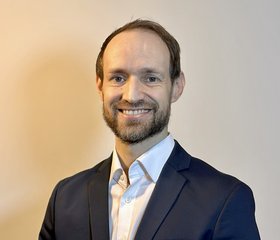
With great passion, Professor Löffler dedicates himself to the development of new and "intelligent" materials. For this purpose, he uses processes in which light synthesizes molecules and shapes them into highly precise materials. This technology holds great potential for sustainable technologies, such as efficient catalysts. With his invention, the multi-material nano 3D printer, Löffler opens up completely new ways to design surfaces so that they can respond to environmental influences. This creates a key technology for adaptive reactors and sustainable applications. In this way, Prof. Löffler uniquely combines process engineering, chemistry, materials science, and biotechnology. “My initial goal was to make an important contribution to disease research, such as vaccine development, with my technical research. Therefore, I am proud that our technology is also being applied in industry. Nowadays, however, I also see the great sustainable potential of our research for the development of new materials,” explains Löffler.
Interdisciplinarity as a Catalyst for Groundbreaking Research
Löffler’s interdisciplinary research fits perfectly with the goals of the Hamburg University of Technology's (TUHH) special research field (SFB) SMART Reactors and the newly acquired excellence cluster BlueMat, both of which focus on switchable surfaces. These are materials whose properties can be deliberately and reversibly changed by external stimuli. For example, they respond to magnetic fields, temperature changes, or fluctuations in pH value and can thereby autonomously perform movements to protect surfaces from adverse conditions. “I am fascinated by how light can be used both to synthesize molecules and to shape materials. In a highly interdisciplinary environment, this combination opens new pathways for biomedicine, energy applications, and materials technologies,” says the scientist. With the appointment of Felix Löffler, an innovative network of scientists working together on future technologies is emerging at TU Hamburg.
Career Step: Heisenberg Program
The Heisenberg funding from the German Research Foundation (DFG) is considered a prestigious award for young researchers in Germany. That the natural scientist Löffler chose TU Hamburg speaks to the university’s growing reputation. Felix Löffler’s path began with physics and biophysics in Heidelberg. His first independent research projects were carried out at the Karlsruhe Institute of Technology. During his stay abroad in 2014 at the University of California, Berkeley, USA, Löffler worked on a project focused on the immunology of dengue fever. From 2017, he was group leader at the Max Planck Institute for Colloids and Interfaces (MPIKG) in Potsdam, where he won the nationwide NanoMatFutur junior competition endowed with 2.25 million euros. In summer 2024, his work was honored with the DECHEMA Award, and he was admitted to the Heisenberg Program of the German Research Foundation. Why Hamburg? For Löffler, many things come together here: “TUHH offers an open, collegial environment – almost like a family,” he says. “And Hamburg itself is to some extent home to me, as my father is from here.” The vibrant, cosmopolitan city with its mix of culture and nature creates the perfect setting for both research and life. Outside the lab, Löffler loves music – both listening and making it himself – and enjoys spending time with his family. Sports activities like jogging help him clear his mind. His enthusiasm for Hamburg is clear: “The city offers a wonderful balance between tranquility and vibrant life.”
TUHH - Public Relations Office
Elke Schulze
E-Mail: elke.schulze@tuhh.de
Phone: +49 30601 4040


