
“Day of Teaching” Highlights AI Perspectives for Universities
Under the motto “Beyond the Prompt,” experts and students at TU Hamburg discuss the opportunities and limitations of AI applications
13.11.2026
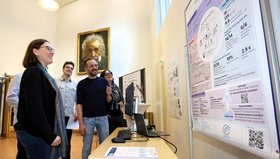
Generative artificial intelligence has long since become part of everyday university life. But what skills do universities need to foster to use AI effectively while also helping to shape its development and application responsibly?
This question was at the heart of the „Day of Teaching“, recently hosted by Hamburg University of Technology (TUHH). Around 200 students, lecturers, administrative and technical staff, and external guests gathered in Building H on campus for the event. Workshops and discussions offered practical insights into AI applications and explored the impact of AI on teaching and learning.
A New Relationship Between Students and Lecturers
Following a welcome address by Prof. Thorsten Kern, Vice President for Education, Prof. Maximilian Kiener delivered the keynote speech, “Beyond the Prompt.” The head of the Institute for Ethics in Technology at TUHH pointed out that technological innovations have often been perceived as a threat to human thinking in the past – from the printing press to calculators and Wikipedia, and now AI.
However, Kiener argued that what matters is not the medium itself, but the principles guiding how we use it. Those who delegate their own work to AI may gain an answer but lose their sense of direction. Prof. Kiener called on universities to establish structures that strengthen precisely this sense of direction. He advocated a three-way relationship between lecturers, students and AI. This includes seminars that encourage critical debate and collaborative thinking. What matters, he stressed, is whether someone can answer the question “Why?” and take responsibility for the results they present.
The subsequent workshops focused on practical applications and good practices in higher education. TUHH’s Centre for Teaching and Learning (ZLL) and Institute for Concrete Structures provided insights into the basic architecture of custom-configured AI tutoring systems. Meanwhile, representatives from the University of Göttingen presented GAIA, an AI tutor that entered its pilot phase in the winter semester.
More Than Half of Students Use AI Daily
Another workshop focused on AI in university administration. Working groups from TUHH’s university-wide AI pilot project “AI in Education” presented the current development of an AI assistant for university regulations. In the workshop “Fly AwAI with Me,” students and TUHH staff members formed pairs, each consisting of a “pilot” and a “co-pilot.” Together, they explored practical questions: How do students use AI? And how can the university better adapt its teaching and advisory services to reflect these practices?
For many students, using AI tools has already become second nature. In summer 2026, TUHH conducted a survey among its students. Of the more than 500 respondents, 55 percent reported using AI tools daily or even several times a day. A total of 87 percent said that AI helps them with difficult tasks, while 76 percent felt that AI enables them to learn more efficiently.
The survey was conducted as part of the “AI in Education” pilot project, which TUHH launched earlier this year. At the start of the 2026/27 winter semester, the university introduced “inTU,” an AI chatbot for first-year students that answers questions about starting university. Over the coming year, Hamburg University of Technology will develop an infrastructure that enables lecturers to create and integrate their own AI tutors into their courses or design interactive teaching formats incorporating AI elements.
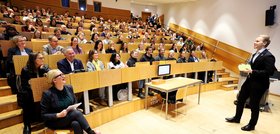
Prof. Thorsten Kern, Vice President for Education at Hamburg University of Technology: “Artificial intelligence is fundamentally changing how we work, teach and learn. As a university of technology, we want to play an active and responsible role in shaping this transformation. Our goal is to equip students not only to use AI, but also to understand how it works, critically evaluate its outputs and recognise its limitations. This Day of Teaching demonstrates how we can work together with students and lecturers to shape the future of higher education.”
Dr. Antonia Gohr, Head of the Student Education Department at Hamburg University of Technology: “AI is of great importance not only for studying and teaching, but also for university administration. We are already using it today and want to harness its potential even more effectively in the future to simplify workflows, speed up standard procedures and free up time for what matters most: personal interaction and individual support. As a university administration, we want to play an active role in shaping this development, strengthen our skills and promote the responsible use of AI. Exchanging ideas and experiences is essential to achieving this.”
PHOTO CREDITS: TUHH/Bittcher
TUHH - Public Relations Office
Michael Tokarski
E-Mail: michael.tokarski@tuhh.de
Phone: +49 30601 3458


