
TUHH Connects Two Living Labs for Soil, Water and Climate Research
New Sister Lab in Shanghai creates a shared platform for research and education exchange between Germany and China as part of the UNU Hub
16.10.2026
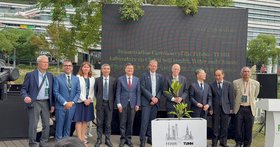
What began on a 990-square-metre site in Hamburg now spans two continents. Hamburg University of Technology (TUHH) and its partners have officially inaugurated a new Sister Lab in Shanghai, China. The new facility establishes a direct link between two research and teaching environments dedicated to global soil health, water and climate. Both laboratories put the objectives of the United Nations University (UNU) Hub “Engineering to Face Climate Change” into practice.
The opening ceremony at the Yangtze River Delta Oasis Smart Valley in Shanghai was attended by representatives of Hamburg University of Technology, the cities of Hamburg and Shanghai, and Chinese partner organisations. Among the participants were TUHH President Prof. Andreas Timm-Giel and Hamburg's First Mayor Dr. Peter Tschentscher. For Timm-Giel and Tschentscher, the opening in Shanghai marked an important stop on their joint delegation trip to Vietnam and China. This year, Hamburg and Shanghai are celebrating the 40th anniversary of their sister-city partnership.
The new laboratory in Shanghai builds on Hamburg University of Technology's CampusLab on Global Soil Health, Water and Climate. The initiative was established and is led by the Institute of Geo-Hydroinformatics (GHI). At the CampusLab in Hamburg, environmental processes can be directly observed, measured and studied. This outdoor laboratory also serves as an important platform for collaboration between Hamburg University of Technology and the United Nations University Institute for Water, Environment and Health (UNU-INWEH) within the framework of the United Nations University Hub “Engineering to Face Climate Change”.
Science Across Borders
The Sister Lab in Shanghai takes this concept a significant step further. The two facilities are to be interconnected, with environmental sensors and monitoring technologies at both locations enabling researchers and students to investigate soils, water, vegetation and interactions between the land surface and the atmosphere under very different climatic and ecological conditions.
In the long term, findings from Hamburg and Shanghai will be integrated using digital technologies, artificial intelligence and advanced data analytics. Students and researchers will be able to compare observations, develop joint experiments and gain insights into environmental conditions at sites thousands of kilometres apart.
The Sister Lab was developed in collaboration with the Feishu Institute Shanghai. The research institution supported the establishment of the Shanghai facility and shares the goal of strengthening international cooperation in science, sustainability and education.
For Prof. Nima Shokri, Head of the CampusLab on Global Soil Health, Water and Climate and Founding Co-Executive Director of the UNU Hub at Hamburg University of Technology, connecting the two sites is just as important as the research infrastructure itself.
“When we opened the CampusLab in Hamburg, our aim was never simply to establish another experimental site,” says Prof. Shokri. “We wanted to create a place where students, researchers and the wider public could experience environmental change directly and where new ideas could be tested in the real world. The Sister Lab in Shanghai takes this idea across borders. We now have the opportunity to observe two very different environments, connect their data and, above all, bring together the people working with them.”
Joint Teaching Activities
In future, the two sites are intended to form a shared learning and research environment for students and early-career researchers. Joint courses, workshops, field measurements and research projects will enable participants in Germany and China to work together on environmental science challenges. At the same time, they will gain hands-on experience with sensor technologies, environmental data, artificial intelligence and field research.
“Climate pressure, soil degradation and water scarcity do not stop at national borders, and neither should the science and education we develop to address these challenges,” says Shokri. “For me, the most exciting part of this initiative is the opportunity to train a new generation of scientists and engineers who are comfortable working across disciplines, cultures and countries. Science can be a very effective bridge between people.”
The Sister Lab also strengthens the international dimension of Hamburg University of Technology's CampusLab concept. With the new site in Shanghai, the initiative is evolving from a local research infrastructure into the foundation of an international network of interconnected environmental living labs.
Prof. Andreas Timm-Giel, President of Hamburg University of Technology: “I am delighted that the Sister Lab allows us to take an idea developed in Hamburg to an international level. Challenges such as soil health, water scarcity and climate change affect us all around the world. Together with our partners and our UNU Hub at TUHH, we are creating a network in which research and teaching across borders drive forward technological solutions.”
Prof. Irina Smirnova, Vice President for Research at Hamburg University of Technology: “The Sister Lab in Shanghai is an important step towards expanding our CampusLab concept internationally and implementing our ‘Engineering to Face Climate Change’ strategy. It opens up new opportunities for students and researchers to exchange knowledge and experience across national borders, explore different perspectives and jointly develop innovative solutions to the challenges of climate change.”
Prof. Luis Seco, Academic Director, Feishu Institute; Professor at the University of Toronto; Chair of the Centre for Sustainable Development at the Fields Institute: „Feishu and Hamburg University of Technology are building a living bridge between Germany and China, transcending borders through mathematics, AI and environmental science to transform shared knowledge into action, scientific collaboration into friendship, and friendship into a better future for our planet.“
Photo: TUHH
TUHH - Public Relations Office
Michael Tokarski
E-Mail: michael.tokarski@tuhh.de
Phone: +49 30601 3458


