
Digital solution: How sustainable is the fish in your shopping basket?
TU Hamburg Career Center’s “Fishing for Experience” practical program brings students together with companies and organizations such as WWF
04.09.2026

Fish species, fishing area, fishing method: Anyone who wants to make sustainable choices when buying fish has to navigate a wealth of information on product packaging. It is often difficult to determine which details are actually relevant for assessing sustainability. As part of the Career Center’s “Fishing for Experience” practical program, a team of students from Hamburg University of Technology (TU Hamburg/TUHH) has developed a prototype for World Wide Fund for Nature (WWF) Germany that addresses precisely this issue: Using a smartphone photo, it can capture relevant information from fish product packaging and cross-reference it with the environmental organization’s assessment database. The results have now been presented at the closing event of the semester program at TU Hamburg.
The student team, comprising students from Data Science and Computer Science, used image and text recognition as well as AI methods to extract information from packaging text. In addition, the team developed a method for automatically matching German terms with the English-language entries in WWF’s assessment database.
Making information easier to use
The specific integration into the “WWF Fischratgeber” (WWF Fish Guide), both online and in the app, is currently under development. However, the project already demonstrates how digital technologies can help make information about the sustainability of fish products in supermarkets more reliable and easier to use.
Franck Hollander, Sustainable Seafood Coordinator at WWF Germany: “The students’ work is a great help to WWF. The IT solution they have developed will make our Fish Guide app even easier to use in the future. Understanding the complexity of fisheries science was certainly a challenge for the students. That makes me all the more pleased with the excellent result.”
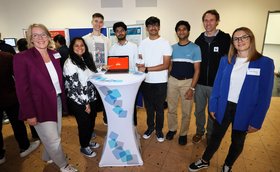
Yash Mahajan, TUHH student and member of the project team: “It was a project with quite a few challenges. We delved deeply into biological terminology while at the same time learning how to work as a team with partners from a completely different professional field. This experience will continue to benefit us beyond our studies. The fact that we were able to support WWF, an organization committed to sustainability, made the work even more valuable to us. We can only recommend the Career Center’s ‘Fishing for Experience’ practical program to everyone.”
Eleven projects, one common goal
The WWF project is one of eleven practical projects that TU Hamburg students worked on during the past semester as part of “Fishing for Experience” and have now presented. In addition to WWF Germany, the participating companies and organizations included Airbus Operations GmbH and Siemens Gamesa Renewable Energy, among others.
“Fishing for Experience” is a program offered by the TU Hamburg Career Center that connects students with professional practice while they are still at university. Each semester, interdisciplinary and international teams of up to six students work on real-world challenges together with the respective project partners. The projects cover a wide range of topics.
Frauke Kasting, Career Center Officer at TUHH: “As a Career Center, we see ourselves as an interface between the university and the world of work. With ‘Fishing for Experience’, we enable students to apply their knowledge in practice, establish contacts with companies and gain their first experience in a professional environment. At the same time, they learn to reflect on their own strengths and areas for development. All of these are valuable experiences that help students shape their own career paths consciously and constructively.”
Prof. Dr.-Ing. Thorsten A. Kern, Vice President for Teaching and Learning at TUHH: “Especially in economically challenging times, it is crucial for a university of technology not only to provide students with an excellent academic education, but also to prepare them for the demands of a changing world of work. Programs such as ‘Fishing for Experience’ do exactly that. Moreover, tomorrow’s engineers must not only be technologically proficient; they must also be able to apply their knowledge to the major challenges of our time. TU Hamburg’s strategic focus, ‘Engineering to Face Climate Change’, encapsulates this ambition.”
Further information on the “Fishing for Experience” program:
WWF Fish Guide:
https://fischratgeber.wwf.de/#/
Images from the event:
https://cloud.tuhh.de/index.php/s/DkqqYkPPBqNwFNK
Photo credit: TUHH/Bittcher
TUHH - Public Relations Office
Michael Tokarski
E-Mail: michael.tokarski@tuhh.de
Phone: +49 30601 3458


