
International Research Community Gathers at TU Hamburg for “biocat2026”
Around 380 experts from 32 countries turn the campus into a hub for sustainable biotechnology at the 12th Biocatalysis Congress
27.08.2026

Sustainability is a key challenge for scientific research – a point powerfully underscored by the long-established “biocat2026” congress. For five days, the campus of Hamburg University of Technology (TUHH) in Harburg was dedicated to the sustainable chemistry of the future. The event brought together around 380 experts from academia and industry. The congress has established itself as one of the world’s most important meeting places for the biocatalysis community. Its focus was on interdisciplinary exchange about the use of enzymes for environmentally friendly industrial production and effective climate action.
In their welcome addresses at Audimax I, TUHH President Prof. Andreas Timm-Giel and Prof. Andreas Liese, Head of the Institute of Technical Biocatalysis, emphasized the importance of scientific research on the path towards sustainable industry. “Biocatalysis is a key technology for chemistry that uses less energy, fewer solvents and no fossil feedstocks,” said Prof. Liese, who chaired the conference together with co-chairs Prof. Johannes Gescher and Prof. Anna-Lena Heins. “This is entirely in keeping with TUHH’s guiding principle, ‘Engineering to Face Climate Change’.” As in previous years, the congress had a strong international profile, with more than half of the participants travelling from abroad. “Climate change knows no national borders, and science must not be held back by political boundaries,” Liese said. “I am therefore delighted that researchers from 32 countries have come to TUHH to help shape the future.”
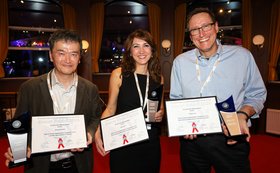
Awards Ceremony Against a Spectacular Backdrop
This year’s packed program of presentations focused primarily on forward-looking technologies such as AI-assisted enzyme research and bio-based solutions for a sustainable circular economy. Alongside traditional scientific presentations, the so-called “Lightning Talks” added a dynamic element to the program. In these rapid-fire presentations, researchers introduced their projects in a concise format lasting just a few minutes. Meanwhile, the numerous poster sessions gave participants an opportunity to explore topics in greater depth and establish valuable contacts.
The highlight of the social program awaited the community on Tuesday evening: the traditional gala took participants aboard the paddle steamer “MS Louisiana Star” for a cruise through the Port of Hamburg. Against the backdrop of the Elbphilharmonie and HafenCity, the Congress Dinner provided the perfect setting for the presentation of the prestigious “biocat2026 Awards”. Researchers from around the world who have made a lasting impact on the field of biocatalysis are eligible for the awards. The prizes are presented in the categories Academia, Industry and Lifetime Achievement by the congress chairs together with the congress’s Scientific Advisory Board.
From Sustainable Processes to Heat-Resistant Ancient Microorganisms
This year’s award for Academic Research went to Prof. Selin Kara, Head of the Institute of Technical Chemistry at Leibniz University Hannover. She completed her habilitation at Hamburg University of Technology, and her pioneering work on enzyme reactions in non-conventional solvents has had a major influence on how biocatalytic processes are carried out today.
Prof. Stefan Lutz, Chief Scientific Officer at the US biotechnology company Codexis, received the award in the Industrial Research category. Research by his team has successfully replaced the solvent-intensive chemistry traditionally used for decades in oligonucleotide production with sustainable enzymatic processes in water.
The Lifetime Achievement Award went to Prof. Haruyuki Atomi of Kyoto University. He established the extremely heat-loving ancient microorganism Thermococcus kodakarensis as a standard model organism for research worldwide. In doing so, he opened the door for biotechnology to an entirely new generation of extremely heat-resistant enzymes.
TUHH has hosted the biennial “biocat” congress since its inaugural edition in 2002. The congress was founded by its current Honorary Chair and former TUHH President Prof. Garabed Antranikian. Biocatalysis is a central research field of the knowledge-based bioeconomy and one of the key technologies for actively combating climate change. Through the “biocat” congress, TUHH – home to the United Nations University (UNU) Hub “Engineering to Face Climate Change” – contributes to achieving the Sustainable Development Goals.
TUHH - Public Relations Office
Kai Hornburg
E-Mail: kai.hornburg@tuhh.de
Phone: +49 30601 4462


