
Nanocosmos: Exploring Light on the Smallest Scale
Prof. Dr. Andreas Tittl is a new Professor at TU Hamburg
18.05.2026
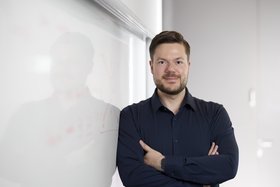
Regular blood tests help many people with diabetes or cancer in diagnosis and further treatment. They allow precise determination of blood sugar levels, detection of pathogens, or identification of other important biomarkers. One of Andreas Tittl’s central research areas is transferring this type of medical diagnostics using light to the nanoscale and miniaturizing it for practical applications. For this purpose, he employs nanophotonics: a discipline that deals with the control and manipulation of light on extremely small length scales, a thousand times thinner than a human hair. Crucial to this are so-called metasurfaces, which consist of tiny nanoantennas. They capture light and focus it much more tightly and finely than conventional lenses could. These metasurfaces act like flat, highly intelligent lenses or filters. “When we ‘trap’ light in these tiny structures, the interaction between light and matter is enormously enhanced,” explains Tittl. His research group uses this special property, among other things, to develop highly sensitive optical biosensors. These can detect individual biomolecules or viruses by reading their unique optical ‘fingerprint.’ “Through miniaturization, this point-of-care diagnostics can be brought directly to the patients’ homes. They would no longer need to travel to the hospital for examinations,” Andreas Tittl explains the advantages of applied nanophotonic methods.
Quantum Light Can Make Communication Eavesdrop-Proof
Another focus of Prof. Tittl’s research is generating and controlling quantum light. For example, metasurface-enhanced generation of single photons is essential for quantum cryptography, i.e., absolutely eavesdrop-proof data encryption. In general, tiny light sources integrated directly on a chip — from nanolasers to single-photon sources — are important building blocks for future photonic chips and quantum information technology. “With the further exploration of metasurfaces, we aim to discover new functionalities in these application areas,” says physicist Tittl. His work has significant societal potential. The compact diagnostic chips could revolutionize medicine — for example, through low-cost and early detection of diseases directly in doctors’ offices or at patients’ homes. And the quantum light sources provide the basis for secure communication, quantum computers, and even novel optical computers inspired by the brain, so-called neuromorphic computing. In this way, they make an important contribution to meeting the increasing energy demands of modern information technologies.
Interface Between Quantum Physics and Materials Science
Professor Tittl takes over as head of the Institute of Photonics at TU Hamburg. His academic career began in southern Germany: after studying physics and earning his doctorate at the University of Stuttgart, he moved to Switzerland to conduct research as a postdoc and later as a fellow at the renowned École Polytechnique Fédérale de Lausanne (EPFL). In 2019, he returned to Germany and founded his own research group at Ludwig Maximilian University of Munich, supported by the prestigious Emmy Noether Program of the German Research Foundation (DFG). There, he completed his habilitation and was most recently a professor of experimental physics. Now, he looks forward to continuing his scientific work at TU Hamburg and significantly shaping the new institute. What fascinates him most about his research is the interface between fundamental quantum physics and modern materials science: “I am impressed by how we can create physical effects through the precise design of nanostructures that do not exist in nature. And at the same time, the path from theory to real application is surprisingly short.” About his choice of TU Hamburg, Andreas Tittl says: “The opportunity to establish and strategically shape a new Institute of Photonics at TUHH from the ground up is very appealing to me. The strong engineering culture and interdisciplinary networking are ideal for translating our concepts into real technologies. I look forward to collaborating with excellent colleagues and participating in the Excellence Cluster BlueMat – Water-Driven Materials.” Privately, the Swabian native is excited about the change of scenery with his family as they move to the Hanseatic city: “After years in southern Germany and Switzerland, I look forward to Hamburg, a cosmopolitan city with a special closeness to the water. We are excited to explore the city in the coming years.”
TUHH - Public Relations Office
Elke Schulze
E-Mail: elke.schulze@tuhh.de
Phone: +49 30601 4040


